
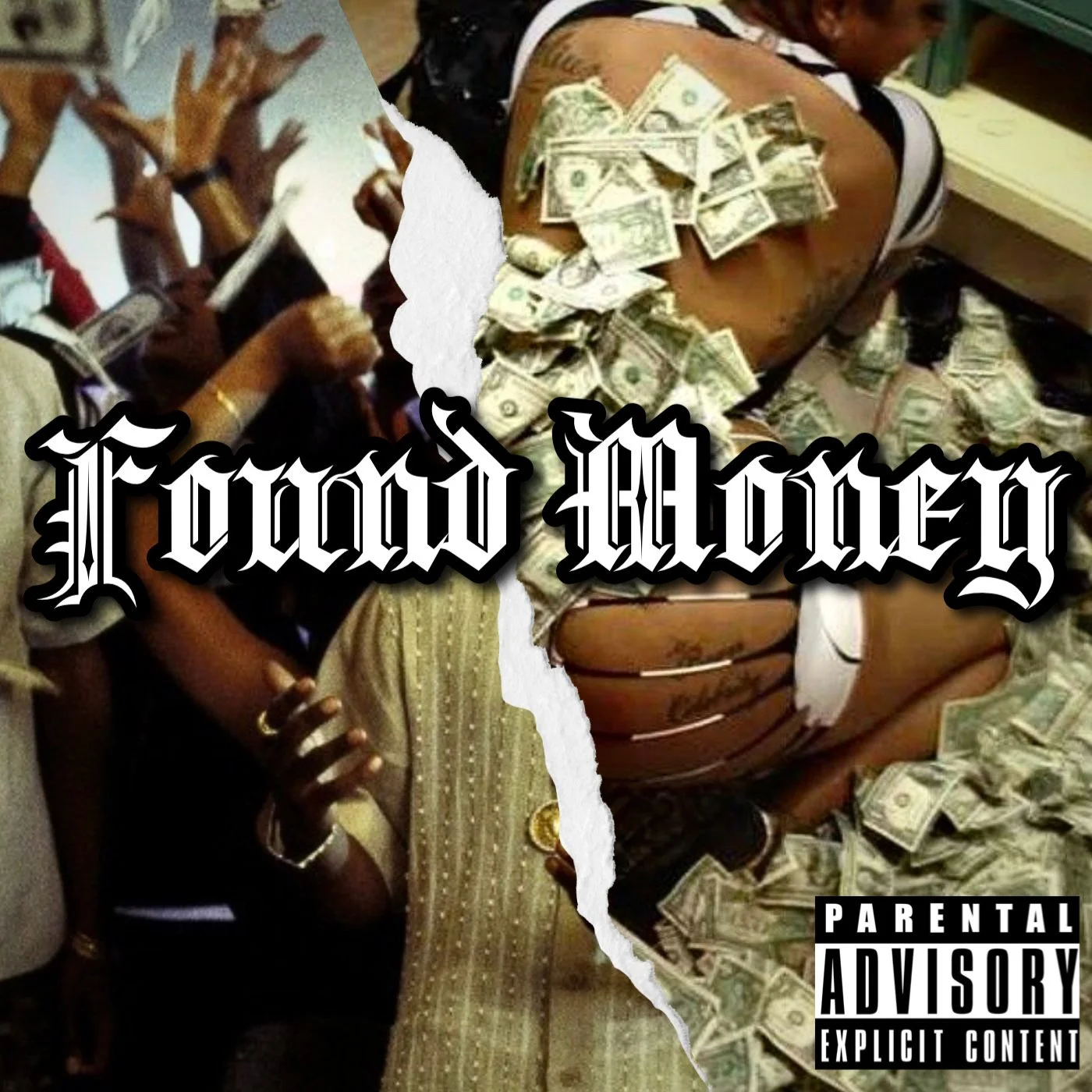
Found Money: The Art of Finding What Was Already There
Found Money begins with a promise:
“Let me go, I’m coming back.”
At first, it feels like exactly what the title Boomerang suggests: departure and return.
So let it go.
The important part is remembering that Deucestacks said it.
Because Found Money is an album that rewards memory.
Words leave one meaning and return carrying another. Images disappear into new subjects. Cultural references become bridges between ideas that initially seem unrelated. A thought can appear finished only to reveal, several bars later, that it was still moving.
That is where the title begins to acquire another meaning.
Deucestacks isn't only talking about finding money.
He is finding value inside language.
FOLLOW THE WORD
One of the clearest examples begins with money:
“I'm stacking my paper up
Like I ain't checked my mailbox”
Money becomes paper.
Paper suggests mail.
Mail produces the mailbox.
Then:
“Mom said be careful son
It's dark outside and hell's hot”
The darkness opens It’s Dark and Hell Is Hot.
From there:
“It's shade in my under tone
I'm aggressive with my statements”
Dark becomes shade.
Shade becomes undertone.
Undertone becomes voice.
Voice produces statements.
And “statements” quietly brings the financial language back.
Money has traveled through language and returned to money.
That movement is the real engine of Found Money.
A word is rarely spent once.
SOMETHING ELSE ENTERS
Then comes Run.
“It's stigmata for a sadist
Crucifixion for disloyalty”
Religious imagery arrives abruptly, but the sequence keeps moving.
“Been the man for a minute
But I'm her baby when she spoil me”
The man becomes a baby.
The baby enters sheets.
The sheets are soiled.
Sex enters birth:
“I was born to fuck the world
With the faith of a mustard seed”
Sacred and sexual language begin occupying the same passage.
STIGMATA → CRUCIFIXION → THE MAN → BABY → SHEETS → BIRTH → WORLD → FAITH → MUSTARD SEED.
You don't have to stop the album and diagram it.
But once you notice what happened, you begin listening differently.
The question becomes less:
What does this line mean?
and more:
Where is this word taking me?
HIGHER
By Higher, that method has become structural.
The song promises elevation until Deucestacks says:
“I'm ascending to a god.
What's higher than that?”
Even the surrounding athletic language moves physically. Tracks become cardio. Speed reaches H-Bolt. Flow reaches Michael Phelps.
Everything is moving upward or forward.
But the most important part may be the question.
What's higher than God?
Found Money doesn't answer.
Not yet.
That's another lesson the album teaches:
An unresolved idea is not necessarily an abandoned idea.CREATION
Paint & Sip takes the system somewhere else.
Painting suggests creation.
Sipping suggests the wine inherent to the setting.
Inside the record, darkness comes to light. Sex produces life. Strokes become brush strokes. A body becomes an easel.
“Dark come to light baby”
Creation becomes artistic, sexual and something more.
The album is learning how to let several meanings remain active simultaneously.
Then Troy Mix explodes that technique outward.
“I been a king of anything
And everything or so it seems”
Kingship enters.
Later come painters, framing, Banksy, Warhol, Rakim, Big Sean, scripture, royalty and non-believers.
One invisible word can connect completely different disciplines:
artist.
Elsewhere Deebo brings chains, Friday and Chris Tucker into the same relay. Stevie Wonder can disappear from one line only for “Ribbon in the Sky” to retrieve him later.
The references aren't decoration.
They're transportation.
WHAT HAS VALUE?
As the album develops, the wordplay begins carrying increasingly personal questions.
Vibes 2 gives us:
“Moves meant laden with purpose soul.
Not for purchase.”
Now value is explicitly separated from price.
Something can possess worth without being available for purchase.
Movement becomes purpose.
Purpose becomes soul.
The crowd says his name.
He thanks God for being alive.
He describes giving in to his:
“calling.”
The album that began by looking for value is starting to ask what value actually means.
Then Catch Me becomes obsessed with movement: past, present, future, speed, pursuit, targets, laps.
Inside it:
“what's a bullet to the hand of God?”
God appears again.
But Catch Me also introduces the possibility that some things don't return.
That doesn't necessarily resolve the promise from Boomerang.
One kind of return may have ended.
The album's first promise may still be moving.
ANGLES
Then Swing gives us:
“An angel whose angles are devilish.
Our sin is flesh.”
ANGEL → ANGLES → DEVILISH → SIN → FLESH.
Later:
“We swinging like it's God.
Homies in the outfield”
God leads back toward angels through Angels in the Outfield, while the outfield supplies baseball and baseball returns us to the song's governing word:
swing.
This is no longer simply wordplay.
It's architecture.
One scheme can disappear while another develops inside it, then return to complete the original thought.
And by now another pattern is difficult not to notice.
Crucifixion.
Faith.
God.
Creation.
King.
Scripture.
Non-believer.
Calling.
The hand of God.
Angel.
Sin.
Maybe it's simply recurring vocabulary.
There is no reason yet to decide otherwise.
WHAT'S HIGHER THAN GOD?
The album finally reaches Stepbrothers.
“Hi hoe I'm God.
Good and all,
but I'd rather be great and enshrined in halls.”
Go back to Higher:
“I'm ascending to a god.
What's higher than that?”
The language has traveled.
ASCENDING TO GOD
becomes:
I'M GOD.
The distance between Deucestacks and the destination has collapsed.
But then the line keeps going:
GOD → GOOD → GREAT → ENSHRINED.
God wasn't the final destination.
Legacy was waiting above it.
To be enshrined is to remain.
To survive your moment.
To become something people return to.
And perhaps that's the most important transformation on Found Money.
The album begins fascinated by acquiring value.
It ends fascinated by leaving value behind.
Money matters.
Language matters.
Family matters.
Purpose matters.
What survives matters.
And yet Found Money leaves something unresolved.
Because before all of the semantic relays, before the gods and kings and angels, before Deucestacks taught us that meanings can disappear and return, he told us:
“Let me go, I’m coming back.”
Some things on Found Money have already come back.
Others haven't.
Maybe they never will.
Or maybe the mistake is assuming the album is finished with them simply because the album is finished.
After all, Found Money has spent eleven tracks teaching us one rule:
A word is rarely spent once.